
A boneless organ that pushes on bone.
The tongue looks soft and simple. It is neither.
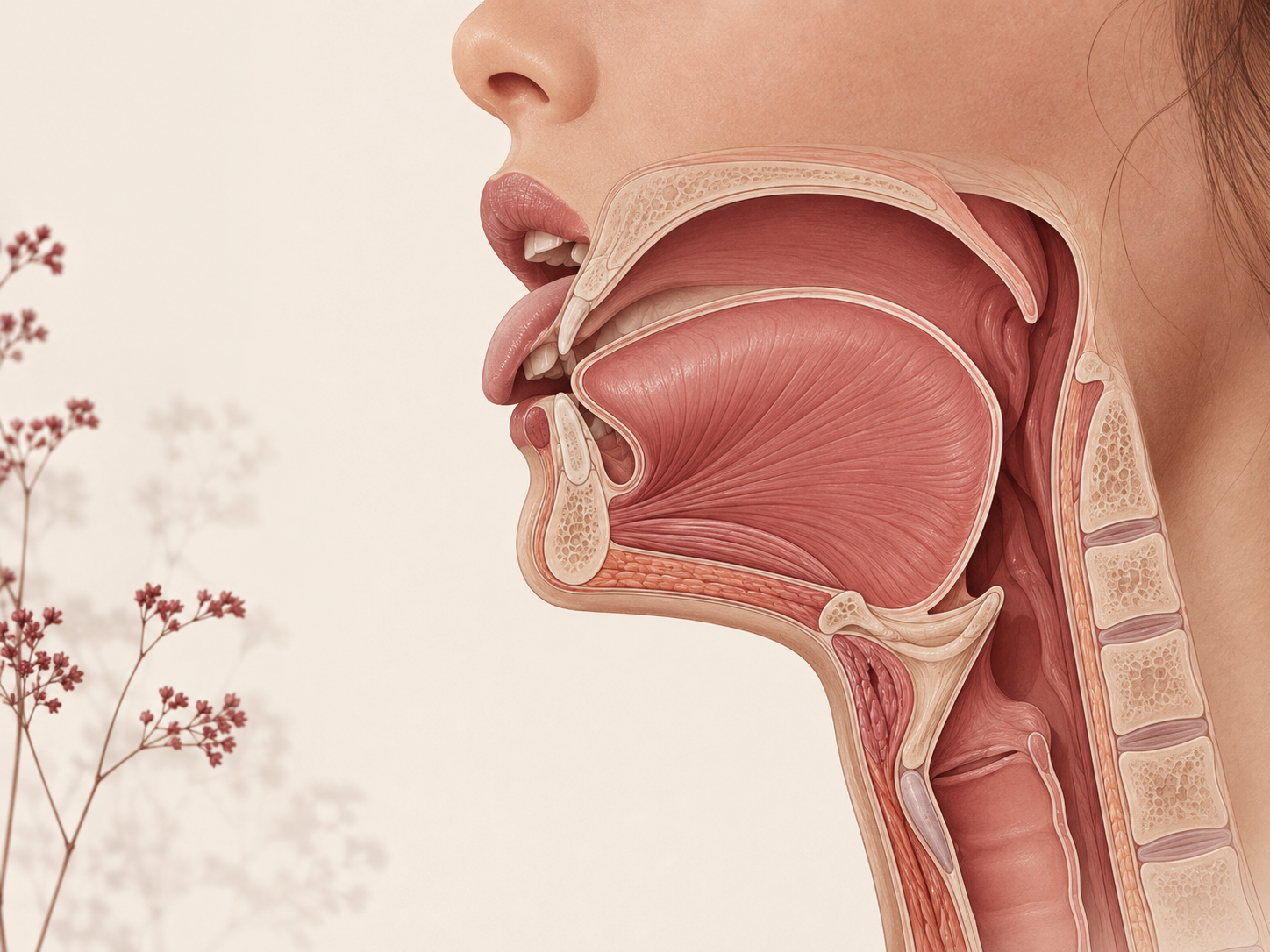
Anatomists describe it as a muscular hydrostat, a structure that can change shape without an internal skeleton. The same broad mechanical idea appears in an elephant trunk and an octopus arm. Layers of tongue muscle run in different directions, allowing the organ to shorten, lengthen, flatten, thicken, curl, brace, cup and stiffen with extraordinary precision.
That engineering matters because the tongue does not float in open space. It spends its life inside the oral cavity, bounded by the palate above, teeth around it, the mandible below, and the throat behind it.
It is therefore both extraordinarily mobile and continuously surrounded by structures capable of adapting to force.
bones inside it
Yet it can stiffen and reshape itself through coordinated muscle contraction.
movement
The tongue changes form in multiple planes rather than behaving like a simple hinge.
rest matters
Resting posture lasts vastly longer than the brief forces produced during a swallow.
Where has your tongue been sitting for the last 30 years?
Imagine a tongue that naturally rests high and centred. Now imagine another that sits low, presses harder against one side of the dental arch, or habitually accompanies a laterally shifted jaw.
Would decades of that difference matter?
Science cannot yet give us a neat equation such as left tongue equals right sacrum. But it also does not support pretending that the tongue has no mechanical influence. A 2023 review of more than a century of orofacial research concluded that the tongue's potential morphogenetic role appears most important at rest and during breathing, although the authors were clear that the evidence remains limited and causality is difficult to establish.
That last part matters. A low or asymmetric tongue may help shape an oral environment. It may also be adapting to an already asymmetric jaw, narrow palate, dental pattern, airway problem or craniofacial structure. Cause and compensation can live together.
A useful experiment: researchers shifted the mandible sideways in people without facial asymmetry and measured tongue and cheek pressures around the lower molars. The pressure balance changed with jaw position. Tongue displacement and tongue pressure changed together.
The authors proposed that this imbalance in tongue and cheek pressure could help explain dental compensation and dental-arch asymmetry seen with facial asymmetry.
That is not proof that the tongue creates every crooked jaw. It is evidence that jaw position, tongue position and the pressure environment inside the mouth are mechanically related.
The head and neck are part of this conversation too. Classic cephalometric research found extensive associations between craniofacial morphology and the way the head sits relative to the cervical column. Head extension relative to the neck was associated with differences in facial height, mandibular inclination, cranial-base angle and nasopharyngeal space.
Association is not causation. But it demolishes the idea that the jaw, skull, airway and cervical region behave like unrelated mechanical compartments.
Can your tongue twist your sacrum?
We do not have good direct evidence for a reliable tongue-to-sacrum mechanism. A compensatory chain through jaw, airway, head, neck and whole-body posture is biomechanically conceivable, but that is not the same as proving that a tongue position predicts a pelvic or sacral rotation. This is where good observation should stay ahead of certainty.
The tongue is also part of your airway.
The tongue occupies a remarkable amount of real estate in the mouth. Its base sits immediately beside the pharyngeal airway. It helps shape the food bolus, moves during swallowing, coordinates with the floor of the mouth and hyoid region, and changes position during speech and breathing.
This is why tongue posture cannot be reduced to the social-media instruction to “just put it on the roof of your mouth.” If someone breathes through the mouth because the nasal airway is chronically restricted, the low tongue position may be part of an accommodation. If the palate is narrow, the tongue may have less room. If the jaw relationship is unusual, tongue posture may reflect that architecture.
The smarter question is not “Where should every tongue be?” It is “What system is this tongue living inside?”
Your tongue is also an ecosystem.
The upper surface of the tongue is rough by design. Papillae, grooves and a large surface area create niches where bacteria, shed epithelial cells, mucus and food debris can accumulate, particularly toward the back.
That coating matters most clearly in one unglamorous area: bad breath. Bacteria on the tongue can contribute volatile sulphur compounds associated with oral malodour. A systematic review and meta-analysis found that adding tongue cleaning to toothbrushing significantly reduced indicators of halitosis and tongue coating compared with toothbrushing alone.
Notice what the evidence does not say. It does not prove that scraping the tongue “detoxifies” the body. It does not establish one perfect number of strokes or one miraculous material. It says something simpler and more useful: physically cleaning the tongue can reduce coating and bad-breath markers.

Try it tomorrow morning.
Before coffee, look at your tongue. Notice what is normal for you. Then use a scraper gently from back toward front. A few comfortable passes are enough. Rinse the scraper and continue with brushing and the rest of your oral care.
If you are gouging, bleeding or making the tongue sore, you are not “cleansing harder.” You are irritating tissue.
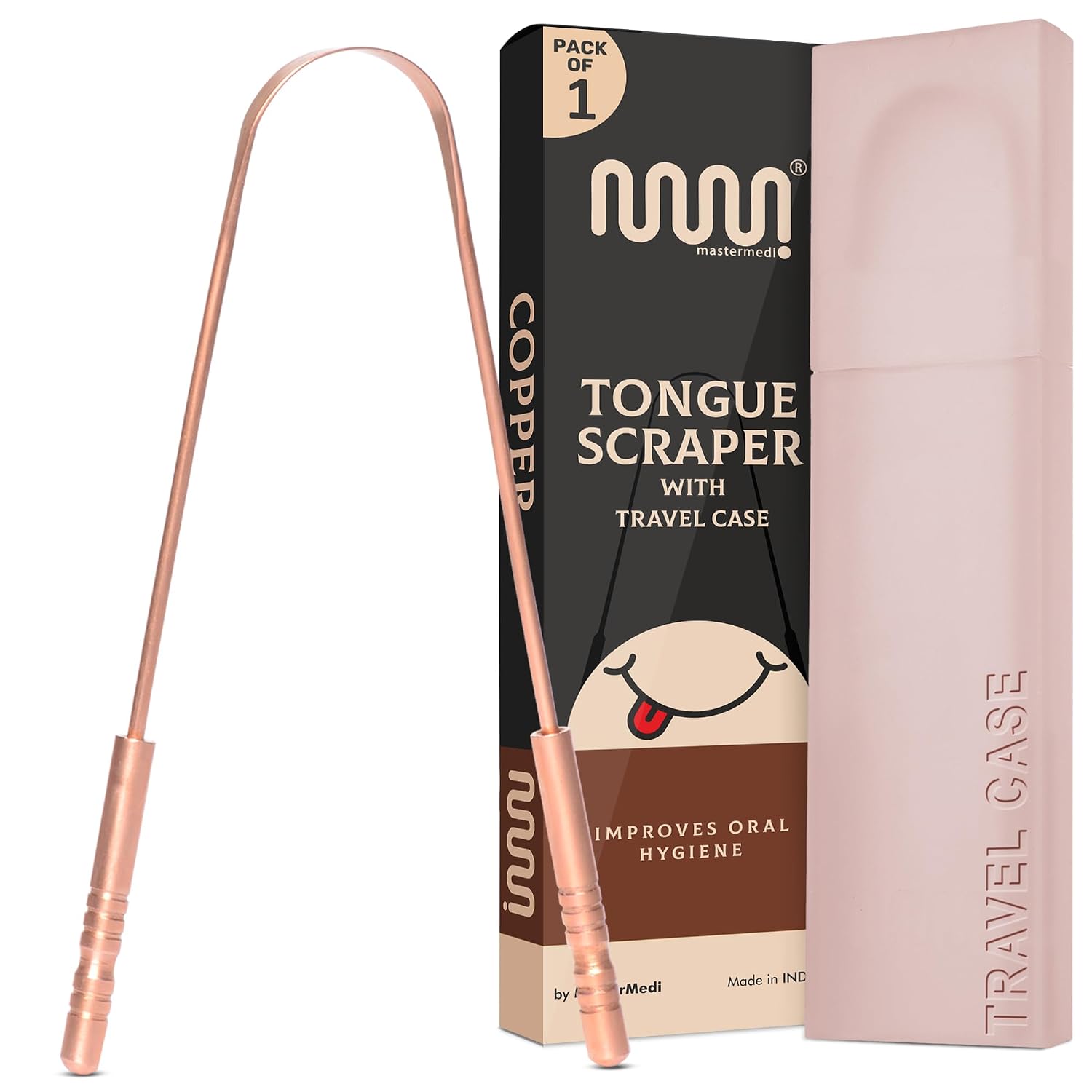
MasterMedi Copper Tongue Scraper
This is the copper scraper I chose for the article. Simple U-shaped design, easy to rinse, and a travel case for keeping it clean when you are away.
View on Amazon →Your tongue can lose strength too.
We talk constantly about aging muscles in the legs, hips, back and hands. Almost nobody thinks about the tongue.
But tongue muscle function can decline. A 2021 meta-analysis included 10 studies and 1,513 participants. People with sarcopenia had significantly lower tongue pressure than those without sarcopenia, and tongue pressure was positively associated with both grip strength and gait speed.
That matters because tongue pressure helps move food through the mouth and participates in swallowing. In older adults, reduced oral function and swallowing problems increasingly appear alongside frailty and sarcopenia.
The surprise is not that the tongue is secretly a biceps. It is that whole-body aging includes structures most of us never think of as muscles.
The old traditions were obsessed with it.
Ayurvedic daily hygiene gave the tongue a regular place in morning care. Traditional explanations used a different physiological language than modern dentistry, and we should not pretend that contemporary research has validated every ancient claim. But the practical habit of cleaning the tongue survived, and modern research has independently found measurable effects on coating, oral malodour and oral-health-related quality of life.
Haṭha yoga went much further. Classical texts describe khecarī mudrā, in which the tongue is turned upward and backward and given a major role in breath, attention and meditative practice. Some historical instructions include deliberately cutting or lengthening the frenulum. That is important history, not a modern self-care instruction, and not something I am recommending.
Still, think about the underlying observation: centuries ago, practitioners were paying extraordinarily close attention to where the tongue rested and what happened when its position changed.
They did not have MRI, electromyography or orthodontic pressure sensors. Their explanatory models were different. But the tongue was already being treated as far more than a tasting organ.
The other power of the tongue.
Human culture repeatedly uses the tongue as shorthand for speech because the instrument and its consequence became inseparable.
We say hold your tongue, bite your tongue, silver-tongued, forked tongue, mother tongue, tongue-tied, and on the tip of my tongue. We do not say “hold your larynx.” The tongue became the symbol.
Biblical literature makes that symbolism central. Proverbs treats the tongue as carrying the power of life and death. James builds an entire argument around the disproportionate influence of something physically small, comparing speech to the tiny mechanisms that can direct much larger forces.
Yoga and Ayurveda disciplined the tongue physically. Biblical wisdom literature disciplined it morally. Other traditions built codes around right speech, truthful speech, restrained speech, persuasive speech and sacred speech.
And modern physiology gives us a fascinating reason to take the metaphor seriously.
Someone tells you, “The biopsy is negative.” Your autonomic state can change in a second.
Someone tells you, “I love you.” Something changes.
Someone humiliates you in front of other people. Something changes again.
The tongue moves a centimetre. Another person's nervous system reorganizes.
Two kinds of tongue hygiene.
Morning
Look at your tongue before brushing. Notice its coating, colour, edges and where it naturally seems to rest. Clean it gently. Brush your teeth. Drink some water. If a persistent sore, lump, patch, pain or unexplained change concerns you, have it properly assessed rather than diagnosing yourself from a colour chart online.
During the day
Catch one moment when you are about to say something automatic, irritated or unnecessary. Wait for one breath. Then decide whether it still needs saying. Same tongue. Two completely different forms of hygiene.
Questions worth asking.
Does tongue scraping actually do anything?
Yes, especially for tongue coating and bad breath. A systematic review and meta-analysis found that adding tongue cleaning to toothbrushing reduced indicators of halitosis and tongue coating compared with toothbrushing alone. The evidence does not establish one perfect scraper, frequency, or duration.
Can tongue position affect the jaw or dental arches?
It can be part of the force environment inside the mouth. Research on orofacial function and orthodontics suggests that resting tongue posture, breathing pattern, cheek pressure, and jaw position interact with dentofacial form. The evidence supports influence and adaptation, but it does not prove that tongue posture alone determines facial shape.
Can a tongue that rests to one side affect alignment?
Long-standing asymmetry can plausibly contribute to an asymmetric oral force environment, and experimentally shifting the jaw changes tongue and cheek pressures. What science cannot yet tell us is how much a decades-long tongue asymmetry causes changes elsewhere versus adapting to an existing jaw, airway, dental, or craniofacial pattern.
Can tongue posture change the cervical spine or sacrum?
The tongue is functionally linked with the jaw, floor of the mouth, hyoid region, airway, and head-neck system. Craniofacial form and craniocervical posture are associated in research. But there is not good direct evidence that a particular tongue posture predicts or mechanically fixes a cervical, pelvic, or sacral alignment.
Does tongue strength change with age?
It can. A meta-analysis of 10 studies involving 1,513 participants found significantly lower tongue pressure in people with sarcopenia, and tongue pressure was positively associated with grip strength and gait speed.
What tongue changes should be checked?
A persistent sore, red or white patch, unexplained lump or thickening, persistent pain, unexplained bleeding, difficulty moving the tongue, or new swallowing trouble deserves professional assessment. Routine dental exams include inspection of the tongue and mouth.
Go deeper.
- Sanders I, Mu L. A three-dimensional atlas of human tongue muscles. Anatomical Record, 2013.
- Gilbert RJ, et al. Anatomical basis of lingual hydrostatic deformation. Journal of Experimental Biology, 2007.
- Kuo YW, et al. Toothbrushing versus toothbrushing plus tongue cleaning in reducing halitosis and tongue coating: systematic review and meta-analysis.
- Danser MM, et al. Tongue coating and tongue brushing: a literature review.
- Martini B, et al. Orofacial myofunctional reeducation: what is the scientific background? 2023 literature review.
- Takada J, et al. Changes in horizontal jaw position and intraoral pressure.
- Solow B, Tallgren A. Head posture and craniofacial morphology.
- Chen KC, et al. Assessment of Tongue Strength in Sarcopenia and Sarcopenic Dysphagia: systematic review and meta-analysis.
- Ayurvedic daily oral-care traditions and tongue cleaning review.
- Effects of tongue cleaning on Ayurvedic digestive power and oral health-related quality of life: randomized crossover study.
- Haṭha Yoga Pradīpikā, chapter 3: historical description of Khecarī Mudrā.
- James 3, the tongue as a symbol of disproportionate power in speech.
- Proverbs 18:21, the long biblical tradition of the 'power of the tongue.'
- MedlinePlus: Dental exam and oral-cancer screening of the mouth and tongue.
Where does your tongue spend its day?
Anatomically, where does it rest? Does it live low? Does it press one side? Does your jaw follow it? Do you breathe through your mouth? Does it look healthy? Do you clean it?
And then there is the other question: What does your tongue spend its day doing to other people?
Encouraging? Criticizing? Teaching? Complaining? Making peace? Starting fires?
Clean what sits on the tongue. And once in a while, clean what comes off it.