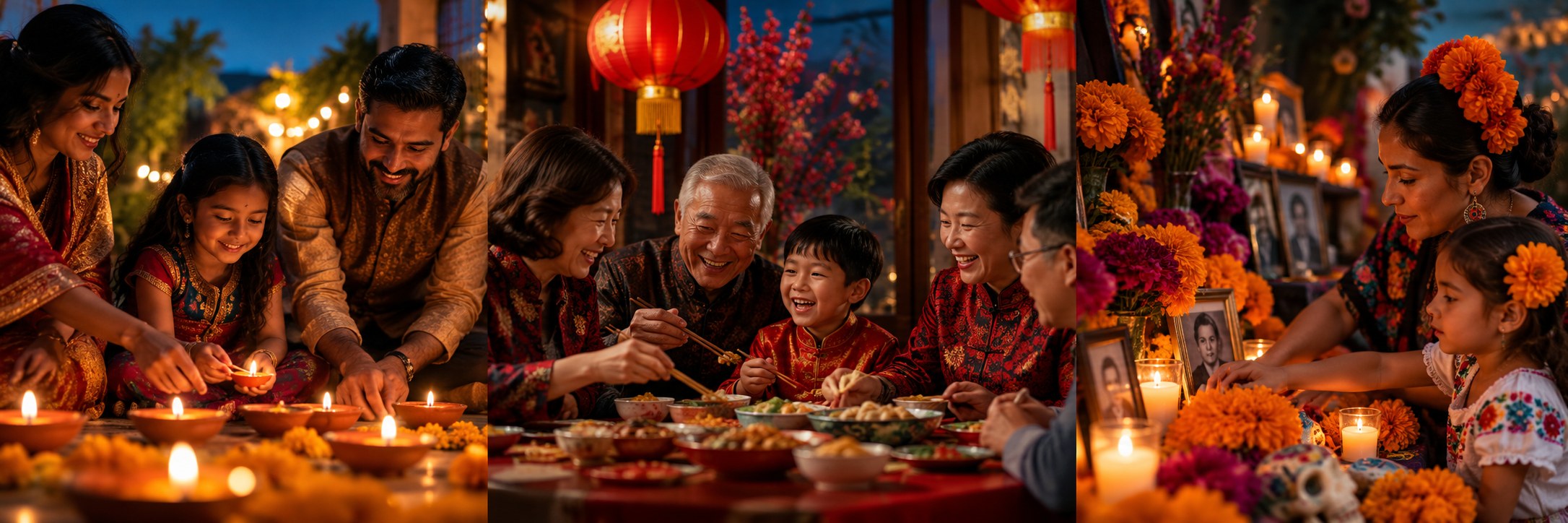
A celebration can make you feel deeply connected. The same celebration can also make you feel judged, exhausted, lonely or trapped. The difference is often not the holiday itself, but what you are expected to do, feel, spend and become.
Expectations come from three directions. Mine: what I demand from myself. Theirs: what other people want from me. Culture: what society says a celebration should look like. When those expectations work together, tradition can be wonderful. When they clash, our bodies can feel the cost.
When a holiday becomes a performance
In a 2023 survey of 2,061 U.S. adults, the American Psychological Association found that 89% named at least one holiday stressor, 41% reported increased stress during the season and 36% said the holidays felt like a competition. Yet 84% also said the season created a sense of togetherness. Those findings are about a U.S. November-to-January holiday period, not a universal description of every country's celebrations. [1]
That combination is the important finding. Celebration and pressure can be present at once. The aim of self-care is not to eliminate obligations or ritual. It is to understand which expectations make belonging possible and which ones turn participation into performance.
Mine. Theirs. Culture.
Psychologist E. Tory Higgins distinguished between our actual self, our ideal self and our sense of what we ought to be. Gaps between these representations can be associated with different kinds of discomfort. This is a general psychological theory, not a special holiday diagnostic test. [2]
The holiday I imagine
“I should feel joyful.” “I must create a beautiful gathering.” “If the family doesn't get along, I have failed.”
Useful question: Is this something I truly value, or an impossible standard I am measuring myself against?
The holiday other people want
“You have to visit.” “We always exchange gifts.” “You can't change this tradition.”
Useful question: What am I happy to offer, and what is beyond my time, energy, budget or emotional capacity?
The holiday we're shown
Advertisements, religious or community customs, social media, gender roles and the idea that everyone is participating.
Useful question: Does this custom help me belong, or am I performing it because I think I should?
Self-determination theory adds another practical insight: well-being and high-quality motivation are associated with autonomy, competence and relatedness. Traditions may feel different when we willingly choose them rather than feel compelled to perform them. This does not mean all duties are harmful. It means our sense of choice and support matters. [3]
What celebrations around the world reveal
These tensions are not exclusive to Western Christmas. Families everywhere negotiate meaning, duty, money, travel, tradition and belonging. But we should not flatten diverse celebrations into a single worldwide experience, or assume that one culture has discovered a stress-free holiday.

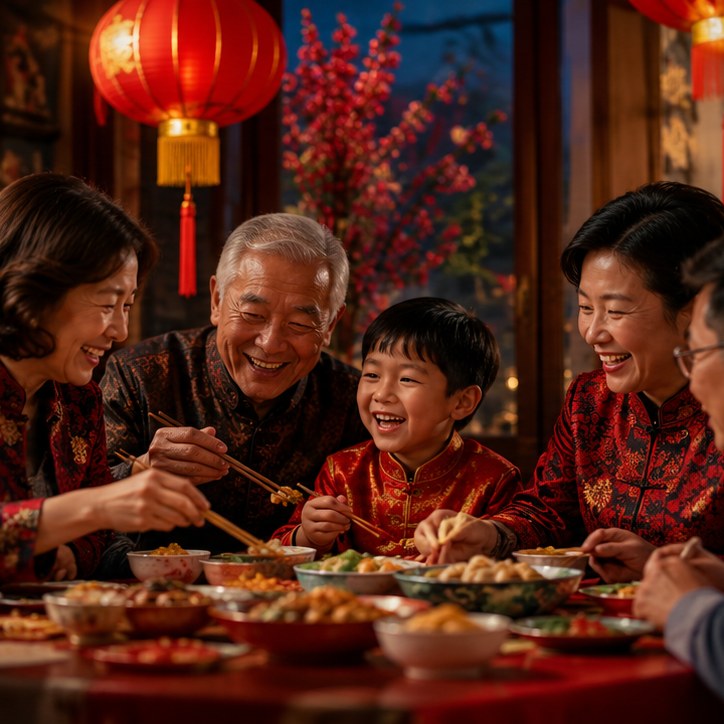
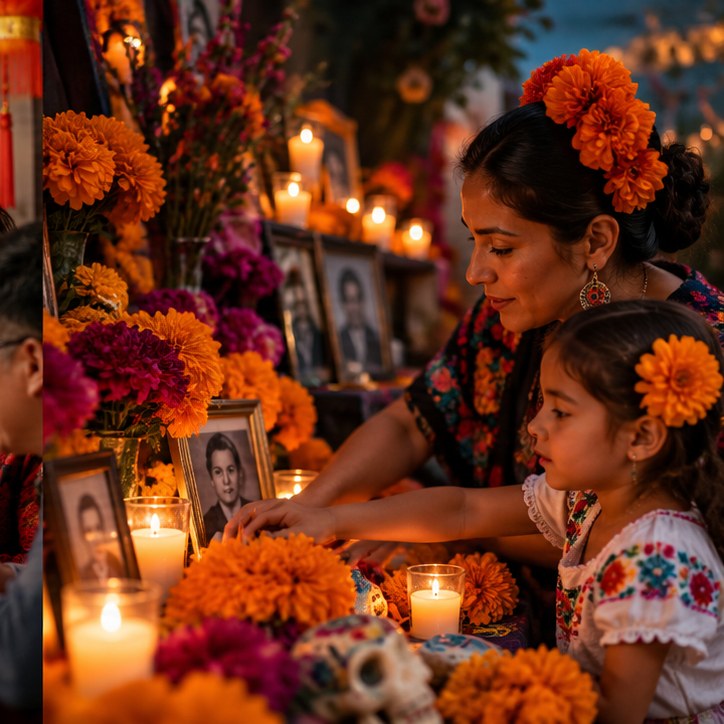
Likewise, religious observances such as Eid, Passover, Vesak and many other festivals may include communal connection and personal commitments. Their meaning differs across communities and individuals. The universal lesson is not that every celebration is stressful. It is that expectations only make sense in their real cultural and social context.
Why an expectation can become a physical strain
Your brain evaluates demands against the resources, control and support you perceive to have. When a situation feels threatening or unmanageable, the sympathetic nervous system can increase cardiac and muscular readiness; the hypothalamic-pituitary-adrenal system can influence cortisol and energy regulation. These are ordinary adaptive systems, not signs of damage. [10]
Pressure may show up as a clenched jaw, altered breathing, restless sleep, headache or tightened shoulders. None of these symptoms proves that holiday stress is the cause, and persistent pain or illness deserves proper evaluation. But they can act as practical reminders to examine whether you've accepted more than you can comfortably manage.
Try a 90-second reset before answering a demand
Unclench the jaw. Let the tongue soften. Rest both feet on the floor. Breathe comfortably, with an unforced exhale. Ask, “Is this a yes because I want to, or because I am afraid to say no?” You are creating a pause in which to choose, not claiming that a breathing technique cures distress.
Loneliness, grief and the pressure to be happy
The World Health Organization estimated in 2025 that about one person in six worldwide experiences loneliness. Loneliness is not identical to being physically alone. It is the distress of wanting connection and feeling it is missing. Someone can attend a crowded gathering and still feel excluded. [6]
The demand to feel festive can also collide with bereavement. A familiar meal, piece of music or empty chair may bring a loved one into sharp focus. You don't need to fake cheerfulness or erase the person from the day. Invite a memory into the occasion if you wish, change a tradition that has become painful, or make a quieter plan.
There is a persistent myth that suicides surge in December. U.S. national data reviewed in 2025 instead showed December typically has the lowest average daily suicide rate. This is a population pattern, not reassurance about an individual in crisis. If someone expresses hopelessness or thoughts of suicide, listen, ask directly, and seek help. In Canada, call or text 9-8-8 at any time; use emergency services for immediate danger. [7] [8] [9]
Make connection specific
“Let's catch up sometime” is easy to lose. “Can we walk together on Saturday morning?” creates an actual opportunity. If you're grieving, you might ask someone to listen to a memory rather than trying to cheer you up. Support and belonging are not the same as compulsory attendance.
The Holiday Expectations Audit
Check the statements that feel true. The tool will show which expectation layers you've selected and suggest a boundary for each. It is an original reflection exercise, not a validated psychological assessment or mental-health risk score. Your selections stay in this browser page and are not submitted.
Four ways to renegotiate an expectation
A meal, gathering, song, prayer or ritual that genuinely creates meaning. Protect the reason you value it.
Shorten the visit, simplify the menu, reduce the guest list or shift the date.
Ask others to cook, host, organise transport, manage gifts or check in on someone.
Release the expense, performance or tradition that no longer serves you and is not necessary.
Try saying it plainly
“I'd love to see you, and I can stay until seven.” “I'm keeping gifts within a smaller budget this year.” “I'd rather remember Dad together than pretend nothing has changed.” “I won't be attending, but I'd like to speak with you next week.”
Boundaries are not a guarantee that everyone will agree. They are an honest description of what you can and cannot offer. If relationships are unsafe or coercive, boundary-setting may require outside support and safety planning rather than a simple script.
What about the spiritual dimension?
Prayer, remembrance, contemplation, service and community ritual can offer meaning when freely chosen. You don't need to adopt another culture's practice or share someone else's religion. Choose the form that is authentic for you. If a tradition brings grief, you may honour it differently. If it brings connection, keep it.
Your holiday does not need to meet every expectation. It needs to be one you can inhabit, with enough room for meaning, boundaries, rest, real connection and whatever feelings are honestly present.
Have a restorative Sunday,
Stephen Backhealer
Self Care Sunday
Research and sources
- American Psychological Association. Holiday stress poll (2023)
- Higgins ET. Self-discrepancy: A theory relating self and affect. Psychological Review (1987)
- Ryan RM, Deci EL. Self-determination theory and well-being. American Psychologist (2000)
- Shaver et al. Time investments in rituals and social bonding: Diwali in two Indian communities (2020)
- Fang H et al. Family companionship and elderly suicide: Chinese Lunar New Year. Journal of Development Economics (2023)
- World Health Organization. Commission on Social Connection (2025)
- Annenberg Public Policy Center. Holiday suicide myth and U.S. data (2025)
- National Institute of Mental Health. Five Action Steps for Helping Someone in Emotional Pain
- Canadian 9-8-8 Suicide Crisis Helpline
- National Center for Complementary and Integrative Health. Stress
Educational self-care information, not a diagnosis or crisis screening tool. Research findings from specific populations are not universal guarantees.