Red light therapy has moved from the clinic to the bathroom shelf in a few short years. The research behind it is real. So is the marketing. Most people who buy a device never get a useful dose from it, because the three things that decide the result are the three things the box leaves out: which wavelengths, how much light actually reaches your skin, and when you use it.
This week is the whole picture. The science, including the parts outside the mainstream. The honest limits. The light you already get for free. And the two devices I would choose, with the settings to use.
What the light actually does
Red light (roughly 620 to 700 nm) and near-infrared light (700 nm and up) pass into the body in a way other light does not. The standard explanation is that an enzyme inside your mitochondria, cytochrome c oxidase, absorbs it. That shifts how much energy the cell makes, releases a short burst of signalling molecules, and changes calcium levels inside the cell.1
It is a tidy explanation. It is also incomplete. Cells engineered to have no cytochrome c oxidase at all still grew faster under 660 nm light.2 Something else is going on.
Two other explanations are worth knowing.
Glen Jeffery's group at UCL proposes that long-wavelength light lowers the viscosity of the water around the tiny rotating pumps that produce ATP, so they turn more freely.3
Scott Zimmerman and Russel Reiter, a long-standing melatonin researcher at UT Health San Antonio, propose that far more melatonin is made inside cells, used right there as an antioxidant, and that near-infrared light is what switches it on.4
Most people know melatonin as the sleep hormone released at night. A large share of sunlight arrives as near-infrared.5 The melatonin idea is still a hypothesis. But it reframes sunlight as something your cells use directly, not only a signal to your body clock.
Why depth matters
Different wavelengths stop at different depths. Red at 630 and 660 nm is mostly absorbed in the skin. Near-infrared at 810 and 850 nm travels further, into muscle and around joints.
- For skin: red.
- For deeper tissue: near-infrared.
- For general use: both together, which is why most serious devices combine them.
The part almost everyone gets wrong
Light follows a curve. Too little does nothing. The right amount helps. Beyond that, the benefit flattens and then reverses.6 The same signalling molecules that help at low levels cause damage at high ones.
More time in front of the panel is not more benefit.
Dose is measured in joules per square centimetre (J/cm²). It depends on two things: how strong the light is at your skin (irradiance, in mW/cm²) and how long you stay there.
seconds = (target J/cm² × 1000) ÷ mW/cm²
Example: 20 J/cm² from a panel delivering 80 mW/cm² at your skin is 250 seconds, a little over 4 minutes.
Most home protocols aim for roughly 20 to 30 J/cm² per area.
The catch is that the irradiance printed on the box is rarely what reaches you. Most manufacturers measure with solar power meters, which read roughly double what a calibrated spectrometer shows. Independent spectrometer tests of five popular panels found every one 33 to 57 percent below its advertised figure.7
Distance matters just as much. Light falls off with the square of the distance. Sit at 12 inches instead of 6 and you lose roughly three quarters of the dose.
What the research supports
Skin. This is where the evidence is strongest. In a controlled trial of 136 volunteers, twice-weekly sessions over 30 treatments improved complexion, measured skin roughness, and collagen density on ultrasound.8 The pairing of 633 nm and 830 nm has its own trial record for wrinkles around the eyes.9
Pain. Promising, and honestly mixed. A 2026 review of 53 studies and about 2,800 patients found an average 32 percent drop in pain scores across knee osteoarthritis, tendon problems, low back pain, and post-surgical pain.10 A 2020 review of 12 trials looking only at low back pain found the effect, compared with sham light, too small to matter clinically.11 Protocols in these studies vary enormously, and dose likely explains much of the gap. Red light supports movement and nervous system work. It does not replace them.
Sleep. Twenty elite athletes received 30 minutes of whole-body red light each night for 14 nights. Sleep scores, blood melatonin, and endurance all improved compared with a group that received no light.12 It is a small study in young athletes and has not been repeated in older adults. Either way, red light does not suppress melatonin the way blue light does, so an evening session sits comfortably inside a wind-down routine.
Blood sugar. Last week was sugar and cortisol. Here is the link. Fifteen minutes of 670 nm light on the upper back lowered the rise in blood sugar after a glucose drink by 27.7 percent over two hours.13 Light on the back changed how the whole body handled sugar.
Eyes and timing. A single three-minute exposure to 670 nm light improved colour contrast vision for a week in people aged 37 to 70. The same exposure between noon and 1 PM did nothing.3 Mitochondria appear to respond differently across the day. This was a purpose-built, low-power device. Do not use a panel on your eyes.
Sunlight, fire, and the light you already have
At sunrise and sunset, the low angle of the sun filters out much of the blue and UV, leaving light weighted toward red and near-infrared. Firelight, candles, and incandescent bulbs give off a similar warm spectrum. For almost all of human history, that was the light people lived under.
Modern LED lighting is heavy in blue with almost no red. Jeffery's group suggests a day spent entirely under it may be a quiet public health problem.13
Be realistic about scale. Measured midday sun delivers around 15 to 21 mW/cm² of red and near-infrared, depending on the season. That adds up over time outdoors, but it is lower than a panel at 6 inches. Sunlight is the foundation. A device concentrates the dose.
Three changes that cost nothing:
- Get outside in the first hour of daylight, even for ten minutes.
- In the evening, use warm incandescent or halogen bulbs where you can, or the warmest LEDs you can find.
- Choose firelight or candlelight over overhead light at night.
The two devices I would choose
These are affiliate links. If you buy through them, Self Care Sunday earns a small commission at no extra cost to you. I chose them against the research first.
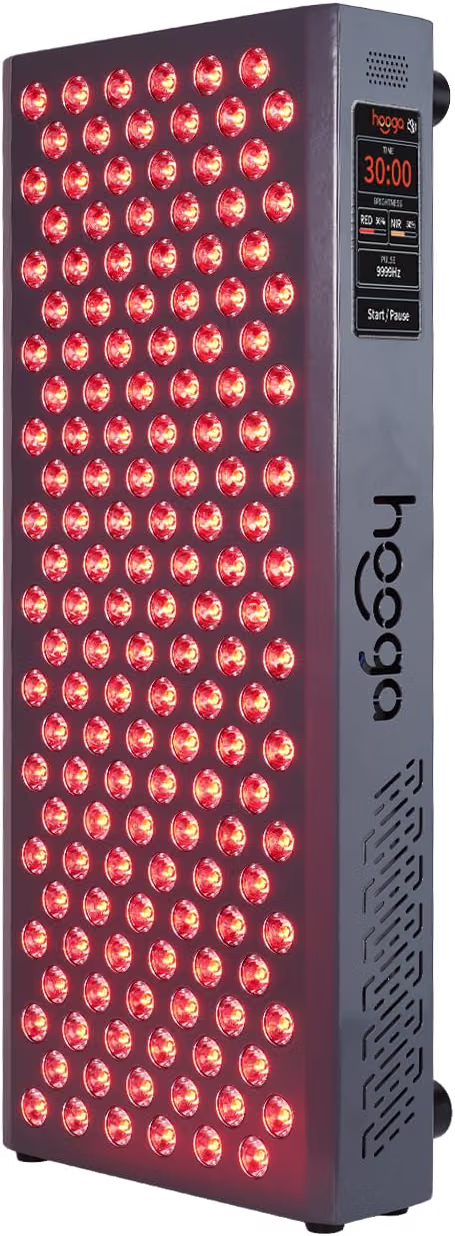
Hooga ULTRA750 panel
Why this one. Every LED carries four wavelengths: 630 and 660 nm red, 810 and 850 nm near-infrared. That covers skin and deeper tissue in one session. Red and near-infrared brightness adjust separately from 1 to 100 percent, which is exactly what good dosing needs: start low and build. It is flicker-free, Hooga states 0.0 μT EMF at 6 inches, and it ships with goggles, a door mount, and a 3-year warranty.
The honest note. Hooga lists more than 161 mW/cm² at 6 inches. I have not found an independent spectrometer test of this model. Given how other panels test, I plan sessions on roughly half that figure.
- Distance: 6 inches for deeper tissue. Further back for the face and general use, allowing for the drop in dose.
- Time: 4 to 6 minutes per area at 6 inches. That lands around 20 to 30 J/cm² at about 80 mW/cm².
- Frequency: four or five shorter sessions a week beat one or two long ones.
- Mode: continuous. Pulse mode at a 50 percent duty cycle delivers half the energy in the same time. Research on recovery points to total dose and wavelength as what matters, not pulsing.14 Some animal work favours 10 Hz for healing,15 which is interesting, not proven.
- Goggles on, every time.
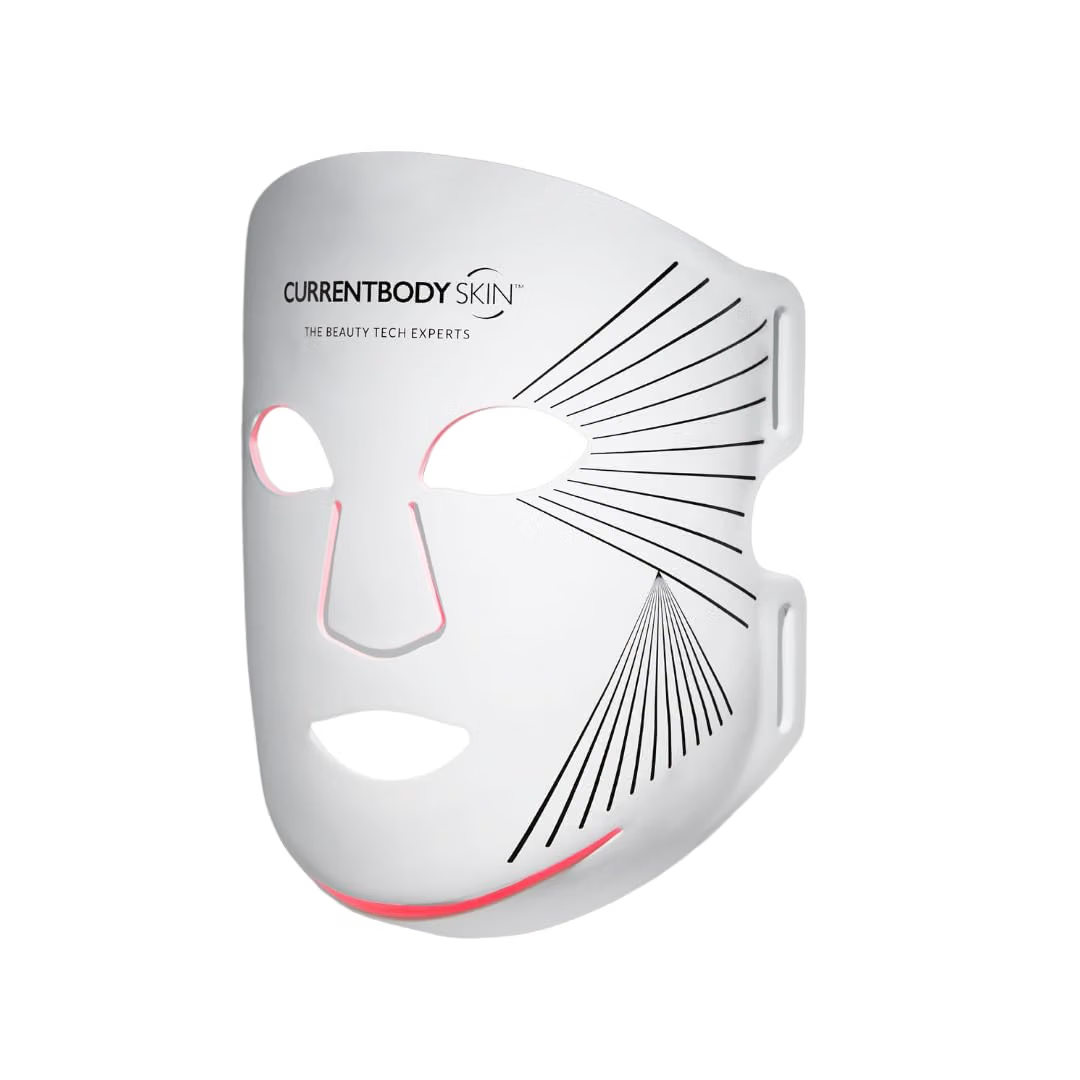
CurrentBody Series 2 face mask
Why this one. 236 LEDs at three wavelengths: 633 nm, 830 nm, and 1072 nm. The first two are the pair used in the published wrinkle trials. The flexible silicone sits close to the face, which keeps the dose consistent from one session to the next. It is FDA cleared.
The honest note on 1072 nm. It reaches deeper into the skin, but the evidence is thinner. One placebo-controlled trial of 79 people found 32 percent better skin texture after 8 to 10 weeks, by the participants' own assessment.16 Earlier 1072 nm trials, on cold sores, were run by a researcher with a financial stake in the technology. Two proven wavelengths, plus one promising one.
- Follow the built-in 10-minute cycle, 3 to 5 times a week.
- Eyes closed under the mask.
- Use it on clean, dry skin. Apply retinol or acids afterward, not before.
- Give collagen changes 8 to 12 weeks.
A simple way to use it
-
Morning
Ten minutes outside in early light. On panel days, near-infrared on whatever is sore or stiff.
-
Evening
Mask or red light on the face. Sit through the session with the Pranayama Reset breath. Then warm, low light for the rest of the night.
Who should be careful
- Eyes. A 12-year-old suffered retinal damage after months of repeated exposure to a red laser device sold for short-sightedness.17 Never stare into a panel. Wear the goggles.
- Check with your doctor first if you have active cancer or a suspicious spot in the treatment area, photosensitive epilepsy, pregnancy (over the abdomen), a medication that increases light sensitivity, lupus, or an overactive thyroid.
- Melasma. Red light is not UV, but heat and local inflammation can darken existing pigment. Start short and stop if spots darken.
- Comfort is the guide. If it makes you feel worse, make it smaller, shorter, or stop.
Next Sunday: collagen and connective tissue, and why the light you just read about is only half of how the body rebuilds it.
See you next Sunday.
Before you switch it on
Is red light therapy safe?
For skin, at sensible doses, generally yes, and there is no evidence it causes cancer. The real risks are to the eyes and for the specific conditions listed above.
How long before I notice anything?
Skin changes usually take 8 to 12 weeks of regular use. In the sleep study, changes showed up within 14 nights.
Morning or evening?
Both have a place. Morning exposure had the effect in the eye research. Evening sessions were used in the sleep research.
Can I use it every day?
Yes, at a moderate dose. Frequent, moderate sessions work better than long, occasional ones. Past a point, more light gives less benefit.
Is sunlight enough?
Sunlight is the foundation, and most people get far too little of it. A device concentrates the dose into a few minutes.
Do I need both a panel and a mask?
No. A panel can treat the face from a distance. A mask gives a more consistent dose to the face with less effort.
Sources
- Photobiomodulation CME part I: overview and mechanism of action. Journal of the American Academy of Dermatology, 2024. pubmed.ncbi.nlm.nih.gov
- Photobiomodulation enhancement of cell proliferation at 660 nm does not require cytochrome c oxidase. Journal of Photochemistry and Photobiology B, 2019. pubmed.ncbi.nlm.nih.gov
- Shinhmar H, Hogg C, Neveu M, Jeffery G. Weeklong improved colour contrasts sensitivity after single 670 nm exposures associated with enhanced mitochondrial function. Scientific Reports, 2021. pubmed.ncbi.nlm.nih.gov
- Zimmerman S, Reiter RJ. Melatonin and the optics of the human body. Melatonin Research, 2019. researchgate.net
- Tan DX, Reiter RJ, Zimmerman S, Hardeland R. Melatonin: both a messenger of darkness and a participant in the cellular actions of non-visible solar radiation of near infrared light. Biology, 2023. pmc.ncbi.nlm.nih.gov
- Huang YY, Sharma SK, Carroll J, Hamblin MR. Biphasic dose response in low level light therapy: an update. Dose-Response, 2011. pubmed.ncbi.nlm.nih.gov
- LightTherapyIQ. Best red light therapy panels: what the spectrometers actually measured. 2026.
- Wunsch A, Matuschka K. A controlled trial to determine the efficacy of red and near-infrared light treatment in patient satisfaction, reduction of fine lines, wrinkles, skin roughness, and intradermal collagen density increase. Photomedicine and Laser Surgery, 2014. pubmed.ncbi.nlm.nih.gov
- Russell BA, Kellett N, Reilly LR. A study to determine the efficacy of combination LED light therapy (633 nm and 830 nm) in facial skin rejuvenation. Journal of Cosmetic and Laser Therapy, 2005. pubmed.ncbi.nlm.nih.gov
- Photobiomodulation therapy in musculoskeletal rehabilitation, mechanisms, clinical evidence, and integrated protocols: a systematic review. Sport Sciences for Health, 2026. scholar.google.com
- Photobiomodulation therapy does not decrease pain and disability in people with non-specific low back pain: a systematic review. Journal of Physiotherapy, 2020. sciencedirect.com
- Zhao J, Tian Y, Nie J, Xu J, Liu D. Red light and the sleep quality and endurance performance of Chinese female basketball players. Journal of Athletic Training, 2012. pubmed.ncbi.nlm.nih.gov
- Powner MB, Jeffery G. Light stimulation of mitochondria reduces blood glucose levels. Journal of Biophotonics, 2024. pubmed.ncbi.nlm.nih.gov
- Leal-Junior EC, et al. Effect of phototherapy (low-level laser therapy and light-emitting diode therapy) on exercise performance and markers of exercise recovery: a systematic review with meta-analysis. Lasers in Medical Science, 2015. pubmed.ncbi.nlm.nih.gov
- Keshri GK, Gupta A, Yadav A, Sharma SK, Singh SB. Photobiomodulation with pulsed and continuous wave near-infrared laser (810 nm) augments dermal wound healing in immunosuppressed rats. PLOS One, 2016. journals.plos.org
- Jagdeo J, et al. Light-emitting diodes in dermatology: a systematic review of randomized controlled trials. Lasers in Surgery and Medicine, 2018. onlinelibrary.wiley.com
- Retinal damage after repeated low-level red-light laser exposure. JAMA Ophthalmology, 2023. pubmed.ncbi.nlm.nih.gov