You have been reading about your nervous system every Sunday for a few months now. That is not a small thing. Something quiet is happening inside your brain as a result.
Most people think of reading as information transfer. You open a piece of writing, absorb some facts, close it, and move on. That is not really how it works, especially when pain is involved.
Reading about something consistently, week after week, does something structural to how your brain processes that subject. It changes which neural pathways are active when you encounter related sensations, movements, fears, memories, and choices in daily life. It literally rearranges how you perceive the thing you have been reading about.
For someone living with persistent pain, this is not a side detail. It is close to the centre of everything.
The brain notices what you keep bringing to it
Deep inside your brainstem sits a bundle of neurons called the reticular activating system. Its primary job is filtering. Your senses take in an enormous amount of information every second. Your conscious mind can handle only a tiny fraction of it. The reticular activating system helps decide what gets through.
It filters based on relevance. Buy a red car and you suddenly see red cars everywhere. Start reading about breathwork and you begin noticing when you hold your breath in stressful moments. Begin reading weekly about your nervous system and you start registering, in real time, the physical signals that indicate whether your system is settled, guarded, threatened, or safe.
This is not wishful thinking. It is physiology. The filter adjusts to match your sustained focus.
When you read about pain consistently, the brain begins building a more accurate map of what is actually happening in your body. The map changes before anything else does.Pain neuroscience education
Pain science has known for some time that persistent pain involves representation. The brain holds maps of the body, maps of threat, maps of what is safe, and maps of what should be protected. In persistent pain, those maps can become distorted. The brain may treat a larger area as threatened. It may amplify signals. It may narrow the range of movement, pressure, or sensation it considers safe.
What is less widely understood is that reading, and sustained attention to pain education, can begin to improve these maps. Not by ignoring pain. Not by pushing through it. By giving the brain better information than it currently has.
Attention trains the filter. The brain starts noticing the signals, habits, and protective patterns you previously moved through unconsciously.
Better explanations reduce threat. Pain is easier to work with when the nervous system understands what it is feeling.
The map can change. The brain is not fixed, and the story it uses to interpret pain is not fixed either.
Reading is not passive
There is a persistent cultural belief that reading is somehow less active than doing. That the real work begins when you put the book down and start moving, stretching, breathing, strengthening, or practising something. That reading is merely preparation.
Neurologically this is not accurate. Reading that requires genuine engagement, where you are following an argument, building a model of how something works, connecting a concept to your own experience, activates prediction, memory, imagination, motor planning, and self-awareness. The brain rehearses. The nervous system begins to try on a different explanation.
This is why reading about breathing mechanics, before you ever try a breath reset, means your nervous system is already primed for the practice. The reading is part of the intervention, not just the preamble to it.
The structure here, a short explanation followed by a deeper article and a useful next step, is not just editorial tidiness. The email plants the concept. The blog deepens it. The next step lands in a nervous system that has already been prepared by the reading. The sequence is the point.
What it does for persistent pain
Most people living with persistent pain have absorbed, over years, a particular story about what their pain means. That story may involve structural damage, inflammation, age, weakness, trapped nerves, old injuries, fragile joints, or a body that cannot be trusted.
Sometimes part of that story is true. Sometimes part of it is incomplete. Sometimes the story is no longer current, but the nervous system is still using it as if it were. That matters, because the brain does not just receive pain signals. It interprets them.
Pain education works, in part, by replacing a threat-heavy story with one that is more accurate. Not more optimistic. More accurate. The distinction matters.
When you read about these things, week after week, the old story begins to lose its grip. Not because you are being talked out of your experience. Because you are being given a better framework for understanding it.
The brain does not just receive pain signals. It interprets them. And interpretation is shaped by what the brain believes about the body it inhabits.Pain science, simplified
The book that made neuroplasticity feel human and possible.
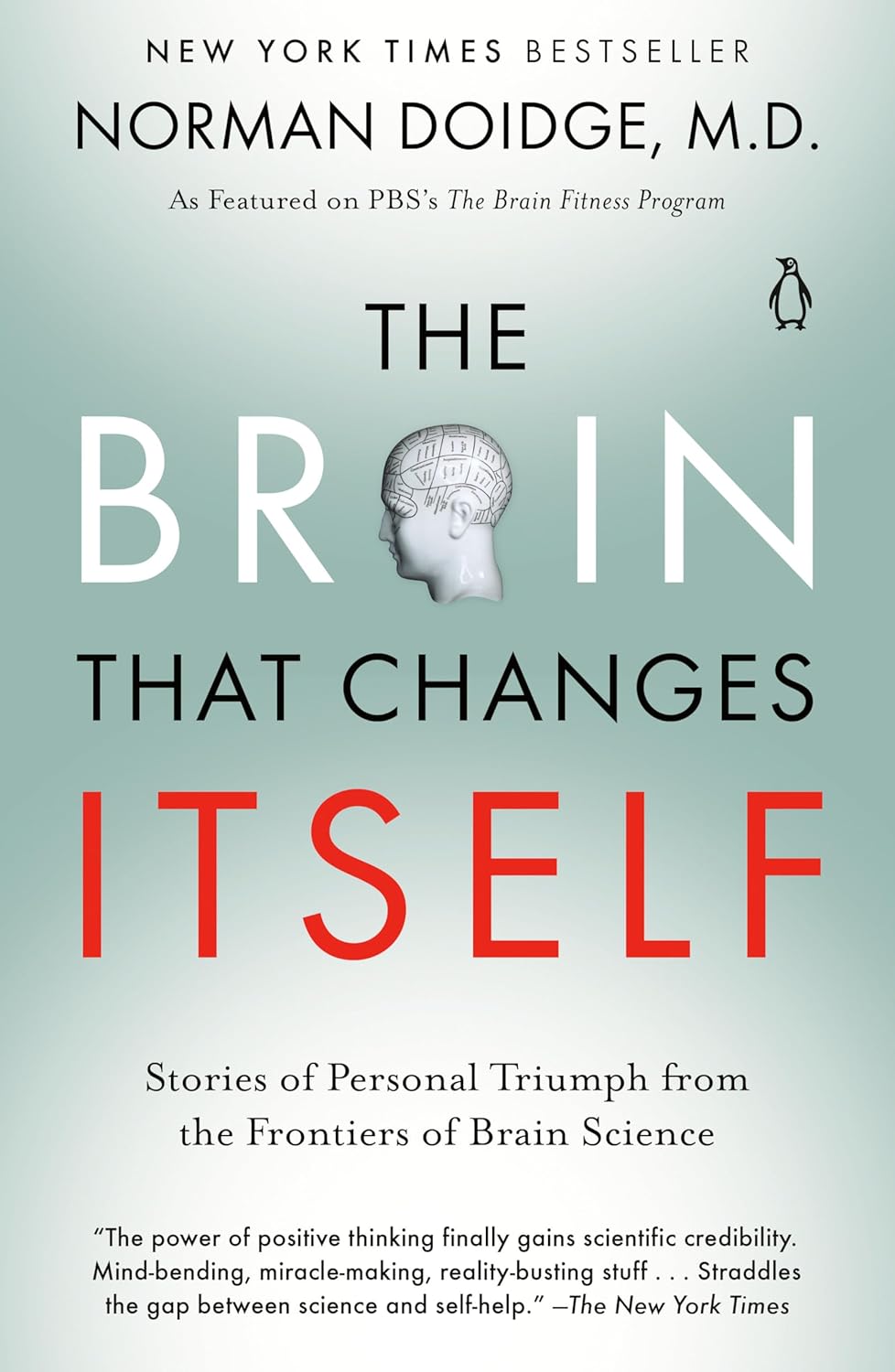
The Brain That Changes Itself by Norman Doidge is one of the clearest mainstream books on neuroplasticity, the idea that the brain can change its structure and function through experience, attention, learning, and repeated use.
That is why it belongs with this article. If reading changes the brain, this book helps explain why. It gives the broader framework for understanding how maps, habits, protective patterns, and even pain responses can shift when the nervous system receives new input over time.
Read this one first if you want the big idea: the brain is not a fixed machine. It is a living, changing organ.
For people whose pain story includes sciatica.
Sciatica Secrets takes the same nervous-system idea into a more practical body conversation. It is about sciatica, yes, but it is also about the way breathing, guarding, fear, movement, load, and body position all shape what the nervous system decides is safe.
The point is not to reduce everything to one muscle, one disc, or one trapped nerve. The point is to give the brain and body a better map. Less panic. More clarity. Better next steps.
If sciatica is part of your story, or someone you love, this is the more specific companion read.
 sci secrets - frontback - amazon (160 x 235 mm).png)
You have been doing this for months already. Not dramatically. Quietly. A few minutes on a Sunday morning, a slow read, a different explanation, a little more curiosity, a little less fear.
That is enough to begin changing the map.
See you next Sunday,
Stephen Backhealer