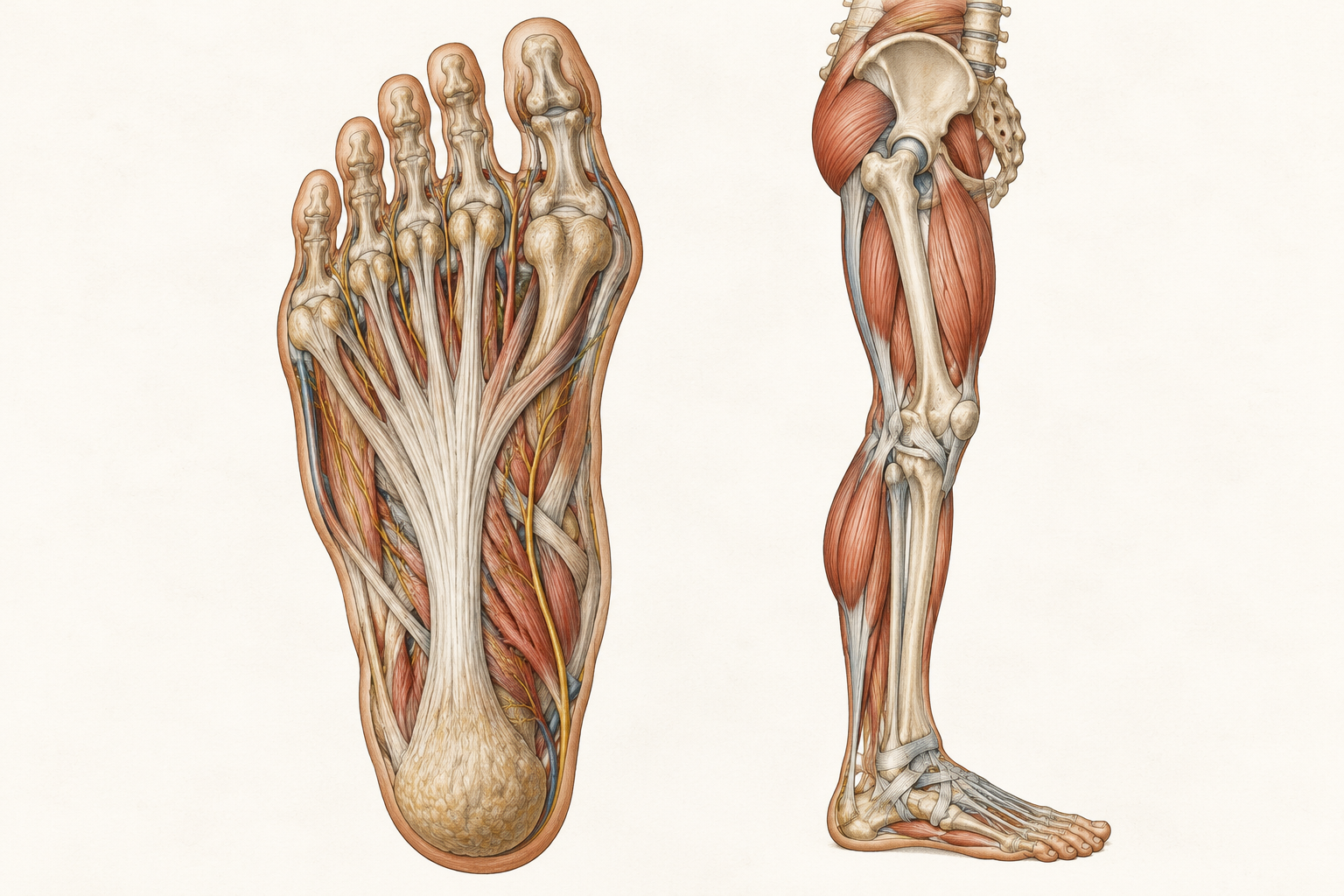
Your feet are not two passive blocks at the ends of your legs. Each foot is a sensory surface, a shock-absorbing structure, and a lever that must become firm enough to move you forward.
They also influence what happens above them. In a controlled walking experiment involving 22 people, researchers altered one aspect of foot loading using wedged sandals and measured changes in shank and femoral rotation and pelvic drop. The findings demonstrate one measurable way changes at the foot can influence movement farther up the leg and pelvis. [3]
Let's follow a step from heel to toe, then look at what happens when we bring sensation and movement back to the underside of the foot.
The foot is a sensory organ
When you stand, receptors in the skin of your sole register pressure, stretch, vibration and changes in the surface beneath you. Researchers have identified four classes of low-threshold cutaneous mechanoreceptor afferents in the sole, the same broad classes found in the hand. In an analysis of single-nerve recordings, investigators mapped how their distribution and sensitivities differ across the sole. [1]
Meanwhile, muscle spindles, tendons and joint-related feedback convey information about muscle length, force and position. Your brain combines these signals with information from the eyes, inner ears, legs, hips and trunk. That continuous exchange helps keep you upright when the ground is uneven or your weight moves toward an edge.
The toes and lateral border are especially interesting: they mark limits of the surface you can balance on. Research has shown that reducing foot-sole sensation changes standing balance and gait. A numb foot is not simply a less comfortable foot; it supplies less reliable information about the ground. [1][2]
One step, four changes in the foot
Walking requires a clever mechanical contradiction: the foot must be compliant enough to accommodate the ground, then comparatively stiff enough to act as a lever. This happens through coordinated joints, ligaments, fascia and muscle activity, not a single arch that simply rises and falls.
The heel accepts initial loading in typical walking. The ankle and leg muscles regulate the transition onto the foot. Landing pattern varies with speed, footwear and individual gait.
The rearfoot and midfoot adapt as weight comes forward. Pronation is normal, and so is the later need to stiffen and re-centre for push-off. Trouble usually comes from long-standing loss of adaptability, poor toe use, or a loading pattern that stays biased too far in one direction for too long, whether that looks more pronated or more supinated.
The calf, smaller foot muscles and hip control forces while your body travels over the supporting leg. Neither the foot nor pelvis acts alone.
The heel rises and the forefoot supports body weight. The big toe extends while the arch and plantar tissues help create an effective propulsive lever.
The big toe is a mechanical event
When the big toe extends at its base joint near the end of a step, the plantar aponeurosis is tensioned. This is the windlass mechanism, a well-described interaction between the toes, plantar tissues and arch. It helps explain why restricted big-toe extension can alter the way a person leaves the ground. Importantly, newer work shows that arch rise during walking is more complex than the textbook pulley model alone. [4]
Don't forget the little toe
The lateral forefoot helps define the outer boundary of support and participate in weight transfer. The little toe is not a duplicate of the big toe: it has a different structural role. If it becomes stiff, curled or difficult to control, it may change how pressure spreads across the outside of the foot. That is worth assessing, especially alongside shoe fit and calf/ankle movement.
In my work, I pay attention to how all five toes function, because limited movement or control in any toe may influence how a person loads the foot and moves through the leg and hip. I often notice reduced little-toe movement alongside tightness in the outer calf and hip, especially in people who spend a great deal of time sitting. I also look closely at the big toe and how its movement relates to push-off, hip flexion and the psoas region. These are relationships I explore through hands-on assessment and movement, while the published biomechanics research helps explain how forces and rotations can travel through the chain.
From foot angle to pelvic motion
During weight-bearing movement, foot and ankle motion can accompany tibial rotation, changes at the knee, femoral rotation, and altered hip or pelvic mechanics. The directions are not universally fixed, and movement also travels down the chain: hip strength, trunk control and walking habits all influence how the foot contacts the ground.
Pronation and supination are both normal parts of foot function. The practical problem is usually not one label by itself, but a long-term pattern in which the foot, toes, and ankle stop adapting well. That may show up as a foot that collapses and never recentres, a foot that stays too rigid on its outer edge, or a toe pattern that no longer shares load well.
Here is a concrete experiment. In 2015, researchers gave 22 participants flat or laterally wedged sandals to increase one pronation-related variable. With the wedge, they measured more rearfoot eversion, shank internal rotation, femoral internal rotation, and altered pelvic drop. Under those laboratory conditions, changing foot loading changed measured walking mechanics through the leg and pelvis. [3]
And what about orthotics?
Orthoses provide another useful example. A review of 22 studies found that certain posted designs modestly reduced peak rearfoot eversion by about 2.1 degrees and tibial internal rotation by about 1.3 degrees in pooled non-injured groups. These are average biomechanical measurements; an individual's response depends on the orthosis, activity and the problem being addressed. Orthoses are used for many needs beyond sport. [5]
In practice, I look beyond labels such as overpronation or oversupination. Watch how the foot loads, whether the toes can move, whether movement is comfortable, and whether a small change makes the walking pattern feel different. Healthy walking needs both adaptability and re-stiffening, not a foot trapped at either extreme.
What years of use leave behind
Our feet reflect a lifetime of loading: shoes that compress the toes, repetitive sport, injuries, long stretches of sitting, and sometimes the simple loss of movement variety. Their shape cannot tell us someone's whole history, but pain, toe deformity, strength and sensory changes may reveal useful clues.
In research involving 312 adults aged 60 to 90, toe flexor weakness and toe deformities were investigated as contributors to fall risk. Other prospective work has linked weaker toes and foot pain with later falls. The findings highlight why toe strength and control deserve attention as part of balance and fall-prevention work. [6]
Traditional reflexology and meridian systems have long treated the feet as important points of influence throughout the body. I find these perspectives worth exploring alongside contemporary anatomy. Their traditional point maps and the pathways measured in modern nerve and biomechanical studies are different kinds of evidence. Here I concentrate on what we can observe directly: sensation, pressure, joint motion, force transfer and changes in movement.
The small red Backhealer ball foot reset
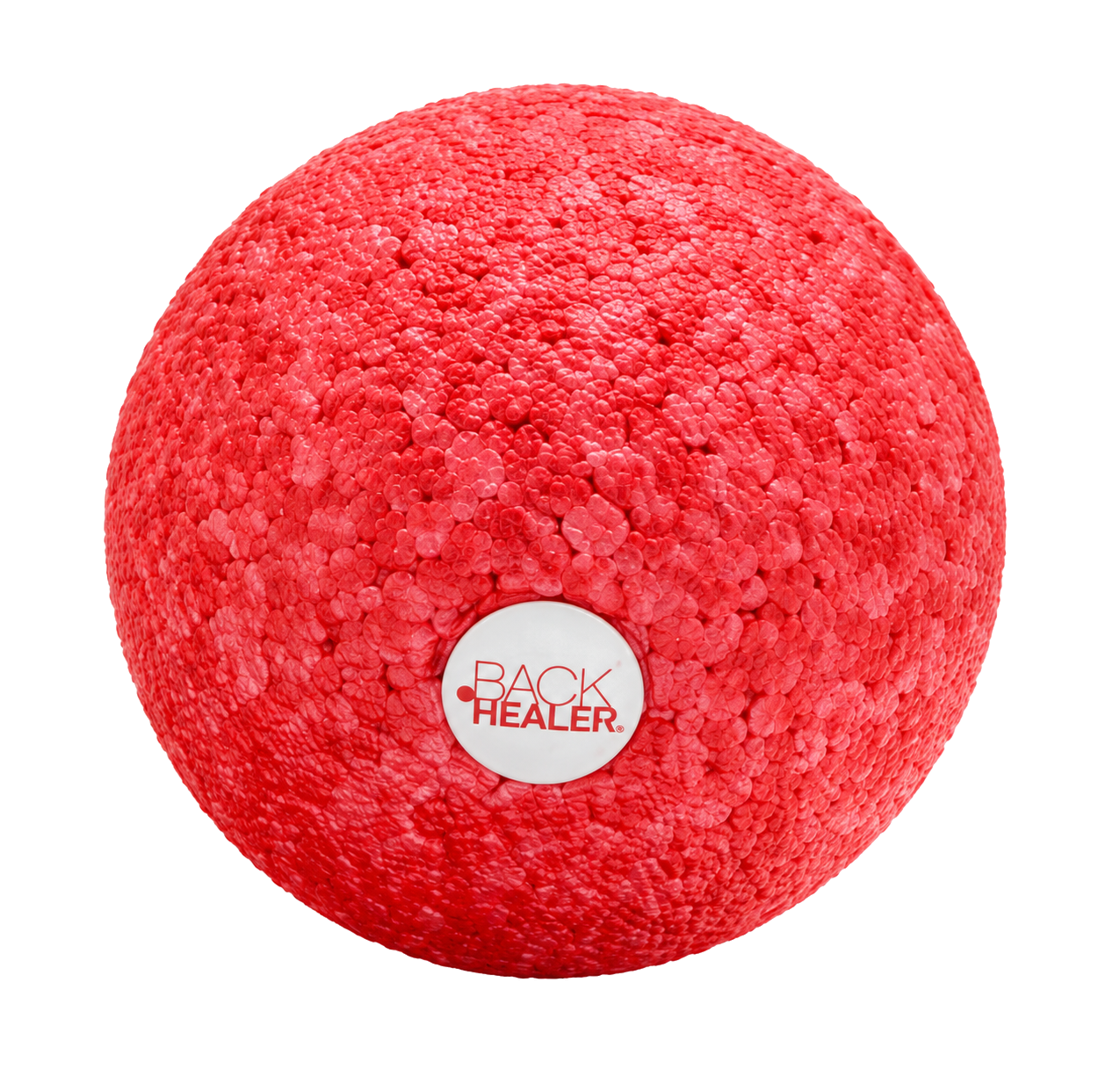
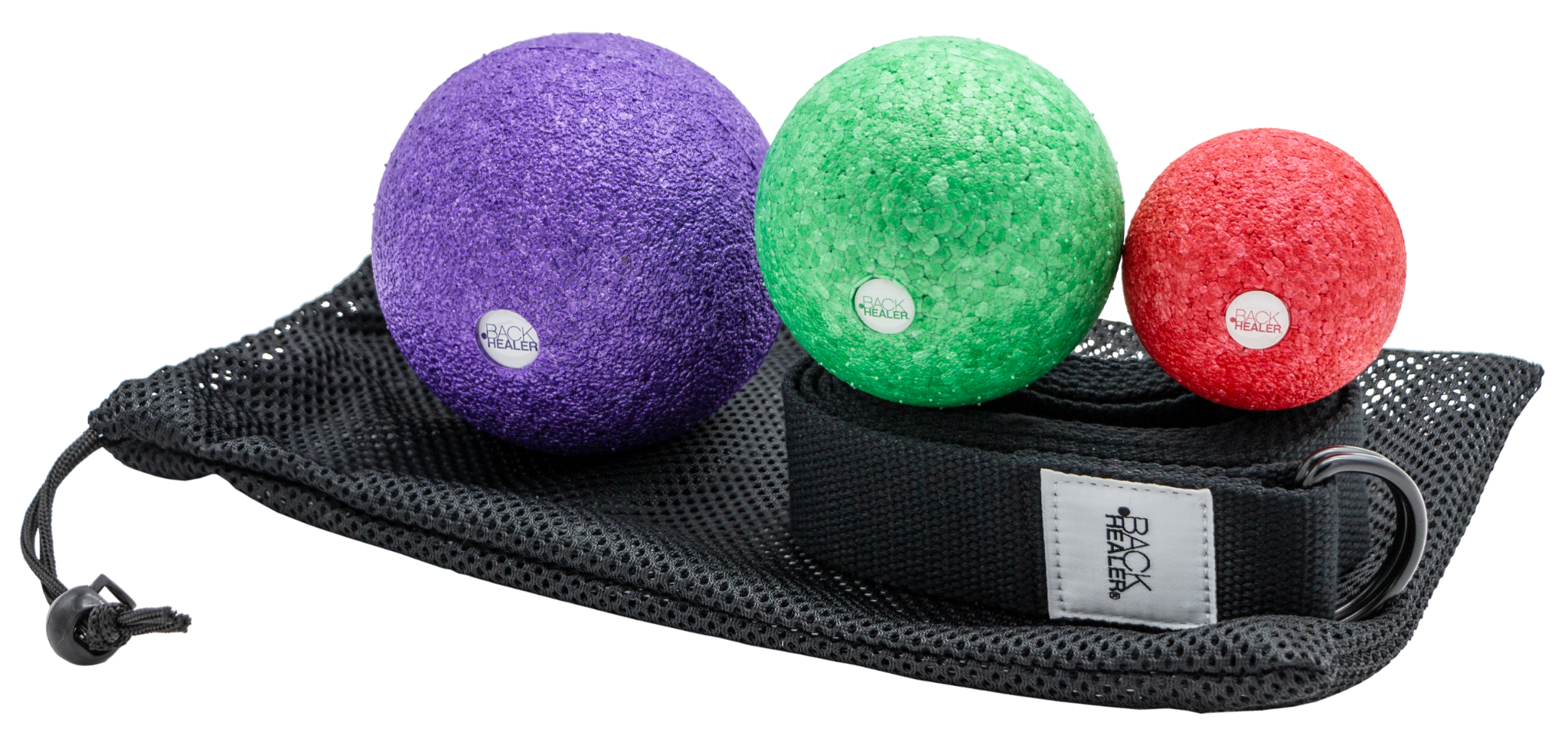
For this practice, I use the small red Backhealer Fascia & Tendon ball, approximately the size of a golf ball. A golf ball can serve as a substitute. The aim is to explore tissue comfort and sensory input under the foot, then immediately see whether anything about your movement feels different.
I use ball work to explore how releasing and stimulating the sole changes comfort, sensory awareness and movement. People sometimes notice an immediate difference in how their foot contacts the ground or how the leg and pelvis feel during walking. The size and duration of that response vary, and ball work can be combined with toe mobility and strengthening when useful.
How to use it, standing or seated
- Before: Walk six easy steps on a clear, level floor. Notice left-right pressure, big-toe push-off, and whether one hip feels different. Notice the movement without forcing a correction.
- Set up safely: Stand beside a sturdy counter with both hands available for support. Or sit in a stable chair with the foot resting on the ball. Choose seated work if balance is uncertain.
- Start light: Place the ball under the central arch. Slowly move it a few centimetres at a time for roughly 30 seconds. Use comfortable pressure, not pain.
- Explore the sole: Move gently toward the inner and outer arch and forefoot, avoiding bruised, injured, numb or sharply painful areas. Do not crush the heel or bear full body weight on a hard ball.
- Use the toes: Remove the ball, then gently spread and lift your toes. Try lifting the big toe independently if comfortable. No forcing or cramping.
- Recheck: Walk the same six steps. Notice comfort, pressure distribution and whether push-off feels different. Pay attention to the size and quality of any change, even if it is subtle.
Time: One to two minutes per foot is plenty for a first experiment. More pressure does not mean more benefit. Skip ball work if you have reduced protective sensation, open wounds, suspected fracture, acute inflammation, severe circulatory problems or unexplained foot pain, and seek individual clinical advice when appropriate.
See the complete Backhealer ball set ↗This is my own Backhealer product. Buying through the link supports my work. A golf ball is a practical alternative; no purchase is needed to try the routine.
What changed after your foot reset?
Try the same movement before and after the routine. Select the changes you noticed, including any areas that feel the same. This simple reflection stores nothing and does not diagnose a foot or pelvic problem.
A short-lived change is useful information too. It can help you decide where to focus further movement, strengthening or hands-on work.
From the floor upward, and back again
The foot continuously exchanges information with the nervous system, while force and rotation pass through the leg during gait. This is a two-way relationship, shaped by the individual body and its history of movement. A comfortable foot can help movement, while stronger hips and better walking habits can also change the way the foot is used.
Pay attention to what your feet can sense, how your toes contribute to a step, and what changes when you give them a little careful attention.
Have a restorative Sunday,
Stephen Backhealer
Self Care Sunday
Research and sources
- Strzalkowski NDJ et al. Cutaneous afferent innervation of the human foot sole. Journal of Neurophysiology, 2018. Read study.
- The sensory role of the sole of the foot: Review and update on clinical perspectives. Neurophysiologie Clinique, 2020. Read review.
- Resende RA et al. Increased unilateral foot pronation affects lower limbs and pelvic biomechanics during walking. Gait & Posture, 2015. Read study.
- The rise of the longitudinal arch when sitting, standing, and walking: Contributions of the windlass mechanism. PLOS ONE, 2021. Read study.
- Foot orthoses and gait: A systematic review and meta-analysis of potential mechanisms. British Journal of Sports Medicine, 2010. Read review.
- Mickle KJ et al. Toe weakness and deformity increase the risk of falls in older people. Clinical Biomechanics, 2009. Read study.
- Backhealer acupressure ball and yoga strap set, actual product information. Product details.
Educational information only. Persistent pain, numbness, falls, new weakness or changes in gait deserve evaluation by a qualified professional. Foot and pelvic symptoms can have multiple causes; persistent problems deserve individual assessment.