Dry brushing: fascia, circulation, and why five minutes changes the morning
A daily ritual that moves the fascia, supports lymphatic flow, and primes the body before anything else does.
I have a structural back condition I have managed my whole life. For many years the tool that made the most difference was the Backhealer ball system: a method of aggressive, targeted myofascial release that breaks down the dense, long-held fascial adhesions that accumulate in a body carrying structural load. That work is still the right starting point for people beginning this journey. The ball goes where nothing else can.
But once the really hard fascia gets broken down through that kind of deep work, the body arrives at a different place. The tissue is more open, more responsive. It no longer needs the same level of aggressive input to maintain what has been gained. That is where dry brushing enters, and it has become, for me, the natural next step after years of ball work. It is a gentler, easier way to keep the fascia moving and the lymphatic system active without spending twenty minutes on the floor every morning.
I now brush five to six mornings a week, right after getting out of bed, before anything else. What I noticed over the weeks of consistent practice was that the fascia moved differently from the moment I stood up. The body was more responsive, less stagnant. The amount of ball work I needed dropped significantly. Just a little movement after the brush and things open up in a way that used to take far more effort to reach.
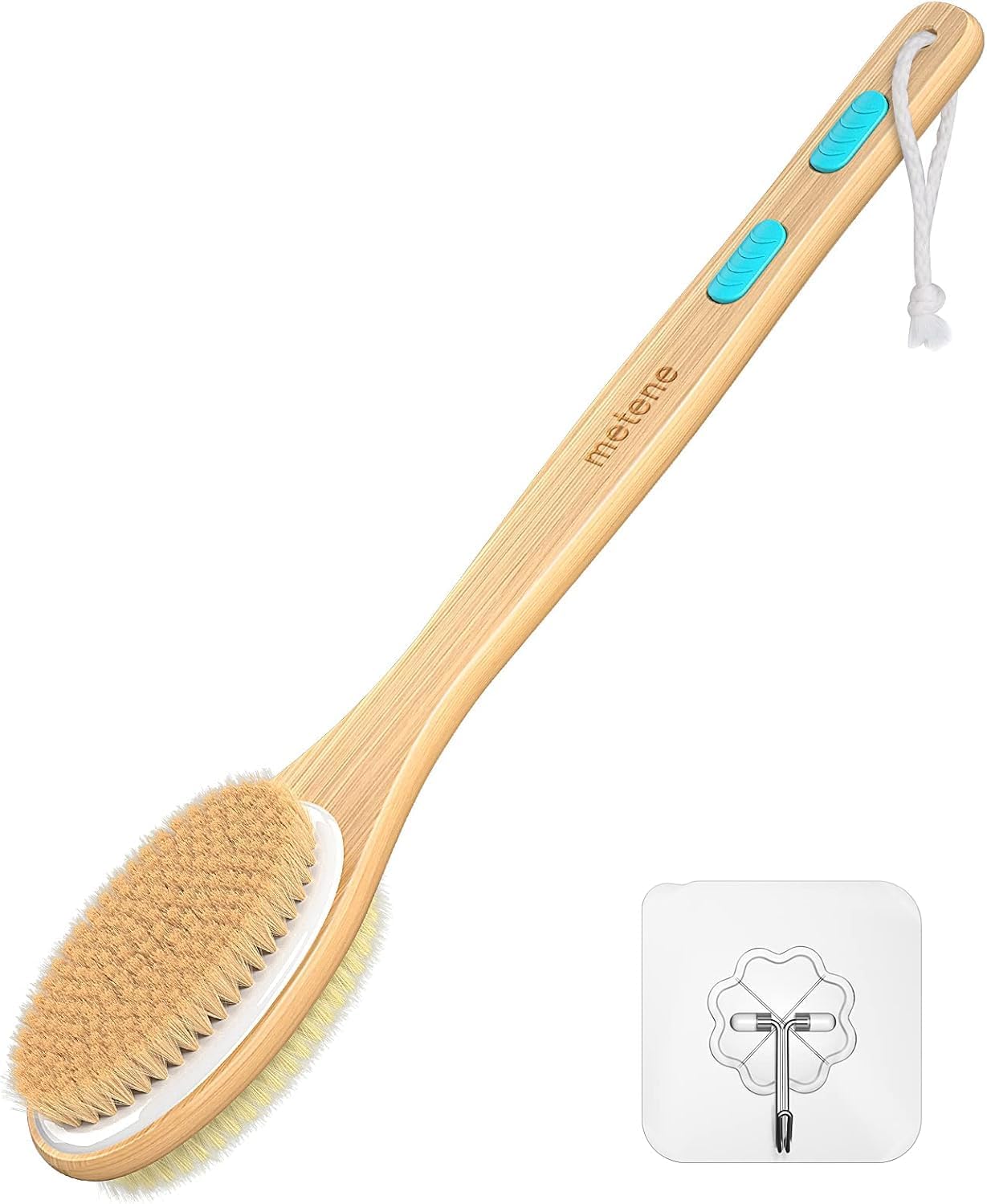
What I use is a long-handled brush, and for my body that is not a preference, it is a practical necessity. The long handle reaches the back, the lower legs, and the shoulders without strain. It also allows real force and strength, particularly on the upper legs and hips where the tissue is dense and needs it. A short-handled brush on a full-body routine is simply not the same practice.
Backhealer ball method first, to break down the hard fascial adhesions. Then dry brushing as the daily maintenance practice to keep what the deeper work opened up. They serve different purposes and work best understood in that order. The ball goes deep. The brush keeps the whole system responsive day to day.
What dry brushing actually is and why it works
Dry brushing is exactly what it sounds like: a firm, natural-bristle brush applied to dry skin in specific directional strokes before showering. The practice has roots in Ayurvedic medicine, where it is known as garshana, meaning friction by rubbing. It has been used for centuries across Indian, Scandinavian, and Japanese wellness traditions. Modern interest has grown as understanding of the fascia and the lymphatic system has deepened.
The mechanism is not mysterious. Firm rhythmic strokes on the skin surface do several things at once. They remove dead skin cells, which is the most obvious and immediate effect. They stimulate capillary circulation just beneath the skin, producing the characteristic warmth and flush. They activate mechanoreceptors, the sensory receptors embedded in the skin and superficial fascia, which send signals that modulate nervous system tone. And they encourage movement of lymphatic fluid through the superficial lymphatic vessels, which run just beneath the skin and have no pump of their own.
None of these effects are enormous in isolation. But they compound. Done consistently, in the correct direction, with the right pressure, the result is a body that circulates better, clears waste more efficiently, and maintains more responsive fascial tissue throughout the day. That is what makes this a practice rather than a treatment.
Direct studies specifically on dry brushing are limited. What exists in the literature is strong evidence for manual lymphatic drainage, for mechanical skin stimulation effects on capillary circulation, and for fascial mechanoreception. Dry brushing combines elements of all three. The absence of large clinical trials does not mean absence of effect. It means this practice has not attracted the research funding that pharmaceutical interventions receive. The biophysical logic is sound and the lived experience of consistent practitioners is consistent.
Three things happening at once
Each time you dry brush, these three mechanisms are active simultaneously. The effect of any one alone is modest. Together, accumulated over weeks of daily practice, they add up to something the body genuinely notices.
Capillary circulation
Rhythmic brushing dilates superficial capillaries and increases local blood flow. Tissue gets more oxygen and nutrients delivered to the surface. The characteristic warmth and skin flush you feel during brushing is this mechanism in real time.
Lymphatic movement
Directional strokes toward the heart and major lymph node clusters encourage movement of lymphatic fluid. The lymphatic system has no central pump. It relies on movement, breathing, and external mechanical pressure in the correct direction to keep fluid flowing.
Mechanoreceptor activation
The skin and superficial fascia are rich in mechanoreceptors: Ruffini corpuscles, Pacini corpuscles, and free nerve endings. Stimulating them sends signals that modulate nervous system tone, reduce local tension, and support a broader sense of body awareness and ease throughout the day.
The correct technique
Direction is the one thing most people get wrong. Always brush toward the heart, starting at the extremities and moving centrally. This mirrors the direction of lymphatic flow and venous return. The sequence below takes between four and seven minutes.
- Open wounds, cuts, or abrasions of any kind
- Sunburned skin or active rash
- Eczema, psoriasis, or other active inflammatory skin conditions
- Varicose veins or areas of broken capillaries
- The face: bristles designed for the body are too firm for facial skin
Outside of the ankles, up the calves
Begin on the outside of the ankle and brush up the outside of the calf toward the knee. Then move to the inside of the lower leg and brush upward again. The feet themselves are awkward to reach with a long handle and can be done separately if needed. Work each position thoroughly before moving up.
Upper legs and hips
Use long upward strokes from knee to hip on the front and back of the thigh. The upper legs and hips respond well to firm circular strokes, harder than you might expect. The tissue here is dense and needs real input. Work the hips and buttocks in circles, always moving toward the groin lymph nodes. This area holds the most stagnation in people who sit for long periods.
Hands, arms, and shoulders
Begin at the fingers and palms. Move up the forearm toward the elbow, then from the elbow to the shoulder and toward the armpit, where a major lymph node cluster sits. The inner arm is more sensitive: reduce pressure here.
Abdomen and chest
Use clockwise circular strokes on the abdomen, following the direction of the large intestine. This is the one area where circular direction specifically matters: clockwise supports colon transit. On the chest, brush toward the center. Use lighter pressure than on the limbs.
Shower after, then moisturise
A shower directly after is very pleasant and washes away loosened skin cells, but it is not mandatory. If you are brushing as part of a morning movement ritual rather than a pre-shower routine, that works equally well. When you do shower after, apply a natural oil or body moisturiser while skin is still slightly damp. Absorption is highest in this window.
Body map: stroke direction at a glance
Every stroke moves toward the heart and toward the nearest major lymph node cluster. The calves: outside first, then inside. Upper legs and hips: firm circles. Arms: fingertips to armpit. Chest: toward center.
LN = major lymph node cluster. Lower legs: outside first then inside, both upward. Upper legs and hips: firm circular strokes. Arms: fingertips toward armpit. Abdomen: clockwise.
Watch the technique demonstrated
This video from a licensed lymphedema physical therapist is one of the clearest and most clinically grounded demonstrations available. The direction, pressure, and sequencing shown align with what the evidence supports and with the approach described in this article.
Dry brushing for lymphatic drainage demonstrated by a licensed lymphedema physical therapist. Pay particular attention to the direction and pressure used on each body zone.
How long before you notice a difference
- Immediately: Skin goes slightly pink and warm. A noticeable flush of energy or alertness. This is the capillary effect and mechanoreceptor activation happening in real time.
- After one session: Skin feels noticeably smoother to the touch. Dead cell removal is immediate and visible.
- After one to two weeks daily: Skin texture improves consistently. The morning brushing begins to feel like a genuine body reset. Circulation changes become more sustained through the day.
- After two to four weeks: Most people report a sense of the body feeling more awake and pliable overall. Fascial effects accumulate here. Morning stiffness reduces. Some notice improved sleep, reduced puffiness in the lower legs, or a general sense of things moving better.
- After two to three months: The cumulative fascial and lymphatic effects are most noticeable at this point. People who continue consistently often describe a different quality of body awareness and comfort that is hard to attribute to any single cause, but that began with this practice.
Frequently asked
See you next Sunday,
Stephen Backhealer
selfcaresunday.org